Execution-grounded · Lifecycle-complete · Game-native

GameXpert-Bench

How Far Are Coding Agents from Expert Game Development?

A unified benchmark that evaluates whether coding agents can create, repair, and improve playable games—not merely write plausible code.

Kun Chen*1,3Haorong Hong*2Peizhong Gao*1,4Jianfeng Lin*2,5Tongxu Luo1,6Yuxuan Xie2Chenxu Liu1Jieling He2Zhongyuan Liu2,†Zeno Zeng1,†

1Hunyuan Team, Tencent   ·   2Lightspeed Studios, Tencent   ·   3CASIA   ·   4Tsinghua University   ·   5HKUST   ·   6CUHK-Shenzhen

*Equal contribution   Corresponding authors

Paper Coming soon Code Coming soon Dataset Coming soon
97generation tasks
100repair tasks
17 × 6optimization chains × turns
3lifecycle tracks
The complete lifecycle

Create. Maintain. Improve.

GameXpert-Bench follows the executable artifact from its first playable version to verified repair and cumulative product refinement.

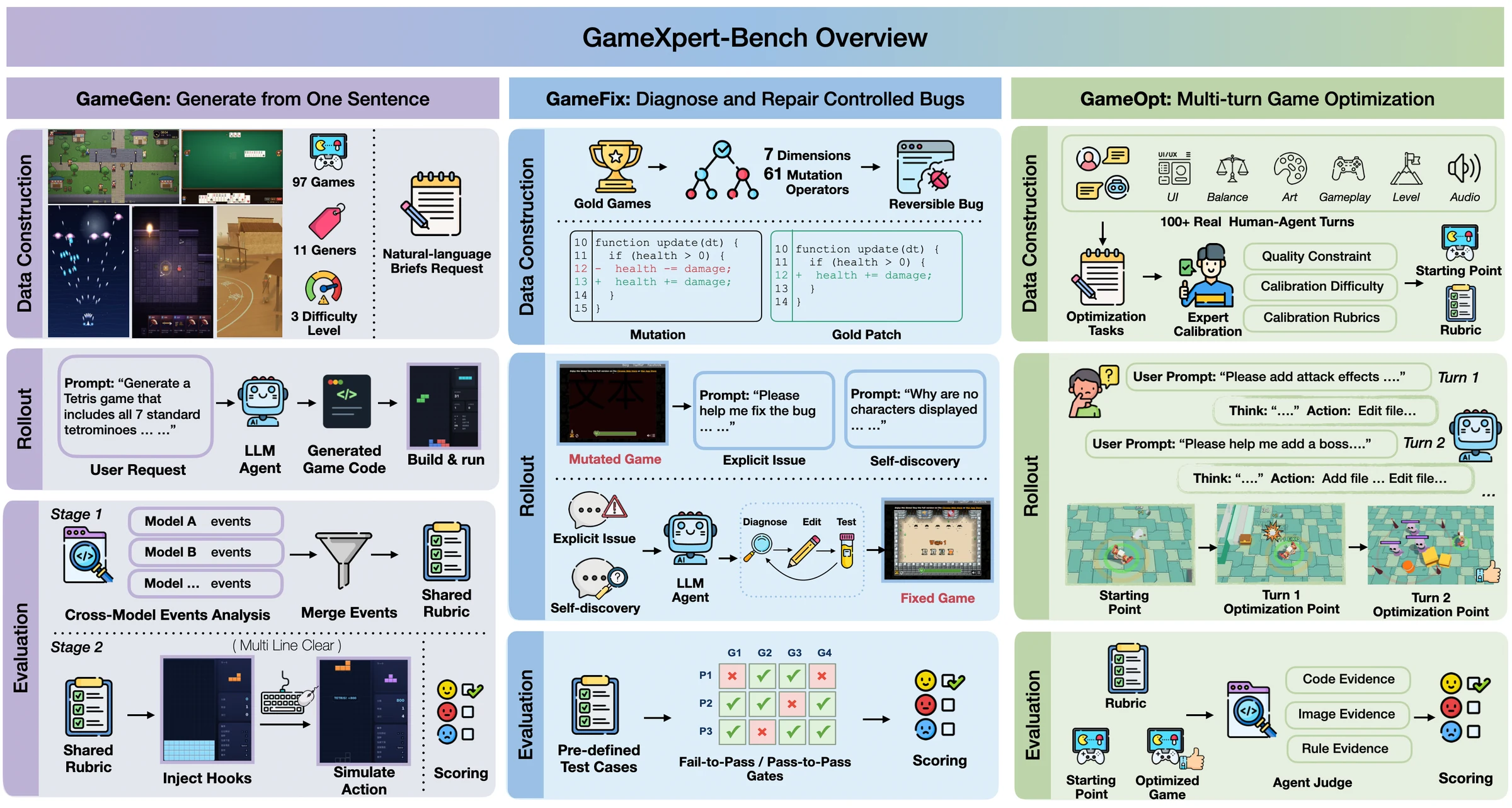
GameXpert-Bench overview showing GameGen, GameFix, and GameOpt construction, rollout, and evaluation
Three complementary tracks connect natural-language requests to observable, executable game behavior.

Why this benchmark

Initial generation quality is only the beginning

Successful game development demands that program logic, visuals, audio, interfaces, interaction, and playability work together in one executable artifact.

Existing benchmarks often focus on a final artifact or one isolated development stage. GameXpert-Bench instead operationalizes three recurring stages found in complete human–agent development trajectories: initial game generation, bug diagnosis and repair, and optimization over multiple turns.

Across all three tracks, current agents are more reliable at producing playable foundations and implementing explicit requirements than at discovering defects, verifying runtime behavior, and preserving functionality across changes.

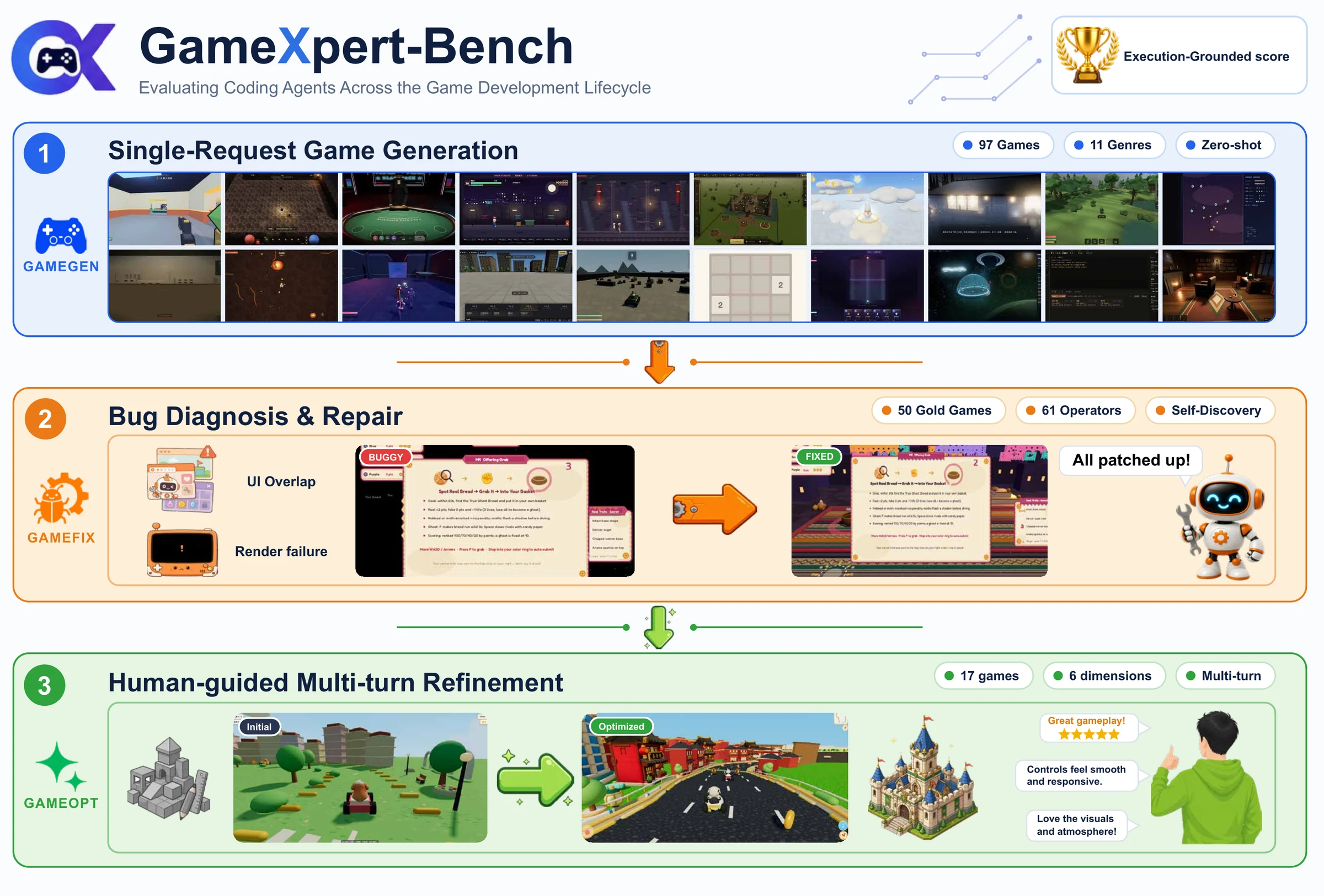
Banner summarizing single-request generation, bug diagnosis and repair, and human-guided multi-turn refinement
GameXpert-Bench evaluates coding agents across the user-facing game development lifecycle.
01

GameGen

Single-request generation

Agents begin in an empty workspace and turn a natural-language design brief into a complete playable game—without supplied assets or a prescribed engine.

  • 97 tasks across 11 genres
  • 53 2D games and 44 3D games
  • Behavioral rubrics, live interaction, code inspection, and human assessment
02

GameFix

Diagnosis and repair

Agents repair reversible defects injected into human-verified Gold Games, both with explicit issue reports and under self-discovery conditions.

  • 50 Gold Game levels
  • 19–27 injected bugs per level
  • Deterministic Fail-to-Pass and Pass-to-Pass regression gates
03

GameOpt

Multi-turn optimization

Agents improve a playable game over six cumulative requests while preserving the core loop and functionality established in earlier turns.

  • 17 games and 102 total requests
  • 701 acceptance criteria
  • Gameplay, level, balance, art, UI, and audio dimensions

Results

Leaderboard

Compare model performance across each stage. Columns and scoring differ by track because the tasks measure distinct development capabilities.

Overall averages completeness, richness, player experience, and visual quality.
GameXpert-Bench model leaderboard

What the benchmark reveals

Three stages, one recurring reliability gap

Each finding pairs the headline result with the execution evidence behind it.

79.7

Playable foundations come first

Claude-Opus-5 leads GameGen overall, yet even the strongest systems lose ground on rich content, robust interfaces, and fully integrated runtime behavior.

39.0

Self-discovery creates a cliff

The leading strict GameFix score remains far from saturation. Hidden defects expose gaps in discovery, verification, multi-bug coverage, and stopping criteria.

93.96

Optimization is uneven

Top agents can preserve requests across six turns, but performance varies sharply by product dimension; balance and level design remain especially challenging.

Trajectory evidence

Later stages inherit the artifact

Complete development trajectories show source size being retained or increased as generation, repair, and optimization requests operate on successive versions of the same game.

GameGen · Finding 01

Playable foundations outpace product completeness

Models cover core behavior more reliably than rich content, polished interfaces, and integrated runtime experience. The gap becomes more visible when moving from 2D to 3D games.

80%+event pass rate for the leading model
Functional coverage

A playable core does not guarantee a complete game

Claude-Opus-5 leads GameGen at 79.7 overall, but richness and player experience lag behind completeness. The component view exposes the difference between “it runs” and “it feels finished.”

3D adds an integration tax. Most models score lower on the 44-game 3D subset; Kimi-K3 is the only exception.
Execution reveals hidden failures. Runtime and player-facing diagnostics catch issues that static inspection cannot establish.
Interfaces remain fragile. Model-level UI misalignment shows why visual plausibility must be checked under actual interaction.
GameFix · Finding 02

Self-discovery—not editing—is the repair bottleneck

Agents repair known defects far more reliably than they discover a complete set of hidden bugs. As tasks demand near-complete repair, success drops sharply.

39.0best Strict score out of 100
Near-complete repair remains rare. Survival curves fall as the required repaired-bug fraction approaches complete coverage.
The checklist changes the task. Removing explicit issue hints exposes discovery, authorization, verification, and stopping failures.
GameOpt · Finding 03

High overall scores can hide uneven product judgment

Multi-turn optimization is not a single capability. Models that look similar overall can have sharply different strengths across gameplay, level design, balance, art, UI, and audio.

58.07points between first and last place
Capability profile

Balance and level design are the weakest dimensions

Across 15 models, balance and level design have the lowest mean scores, while audio is strongest. A single overall number cannot show whether an agent improves the game coherently.

Performance is non-monotonic. The middle turns are weakest, but turn order and requested dimension remain confounded.
Implementation is not integration. Final-product judging separates isolated edits from coherent, regression-free improvement.

Reference

Citation

Publication identifiers will be updated when the preprint is released.

@article{chen2026gamexpertbench,
  title   = {GameXpert-Bench: How Far Are Coding Agents from Expert Game Development?},
  author  = {Chen, Kun and Hong, Haorong and Gao, Peizhong and Lin, Jianfeng and Luo, Tongxu and Xie, Yuxuan and Liu, Chenxu and He, Jieling and Liu, Zhongyuan and Zeng, Zeno},
  year    = {2026},
  note    = {Preprint}
}